Core default
06BashGlobGrepReadEditWrite
 Claude KISS
v0.7.1 Same Claude Code. Your defaults.
You can love Claude Code and still want control over what surrounds it. Claude KISS
keeps the same binary, account, and sessions, while giving you a focused prompt, six
core tools, and explicit switches for everything else. Your normal claude
stays untouched.
curl -fsSL https://claude-kiss.com/install.sh | shRequires Claude Code. No sudo. No wrapper telemetry. No auto-update.
The principle
Claude KISS does not replace the model or build another agent runtime. It controls the layer where prompts, tools, integrations, and handoffs become ambient defaults. KISS points at the harness, never at the quality of the work.
The surface
The launcher requests six coding tools by default. Add a common capability when the task needs it, and combine switches when it needs more.
BashGlobGrepReadEditWriteCLAUDE_KISS_WEB=1CLAUDE_KISS_SKILLS=1CLAUDE_KISS_DELEGATION=1CLAUDE_KISS_MCP=1
Managed defaults suppress bundled workflows, official marketplace autoinstall,
Claude.ai skill sync, Chrome integration, agent view, artifacts, connectors, remote
control, and auto memory. Native CLI
overrides, settings, hooks, and plugins remain live and can change the effective
surface. EndConversation may also appear conditionally as a safety tool;
it does not add file access.
Observed starting context
In this captured Opus 5 comparison, the Claude KISS default started with 33.4k fewer estimated tokens in context—about 80% less than ordinary Claude Code.
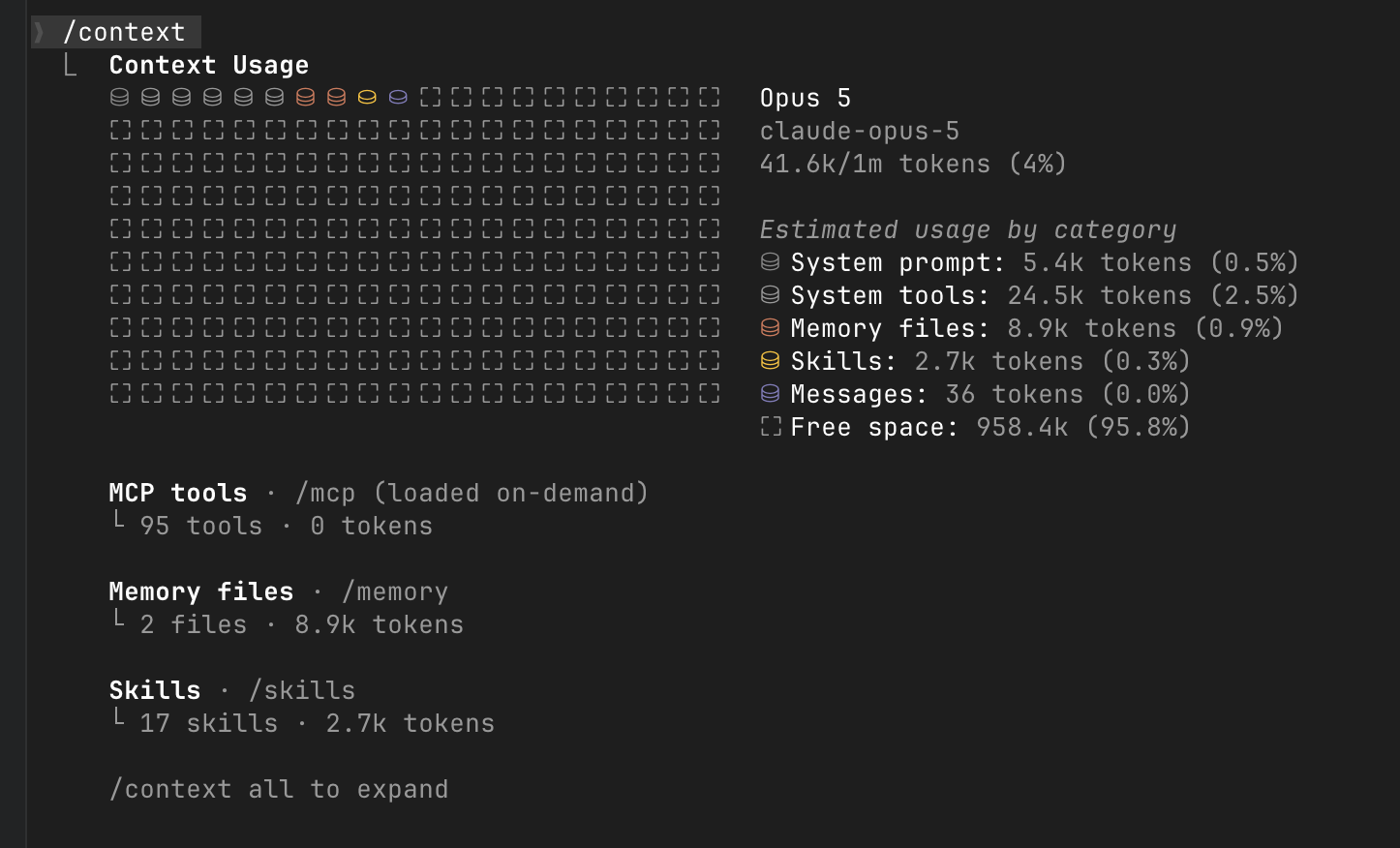
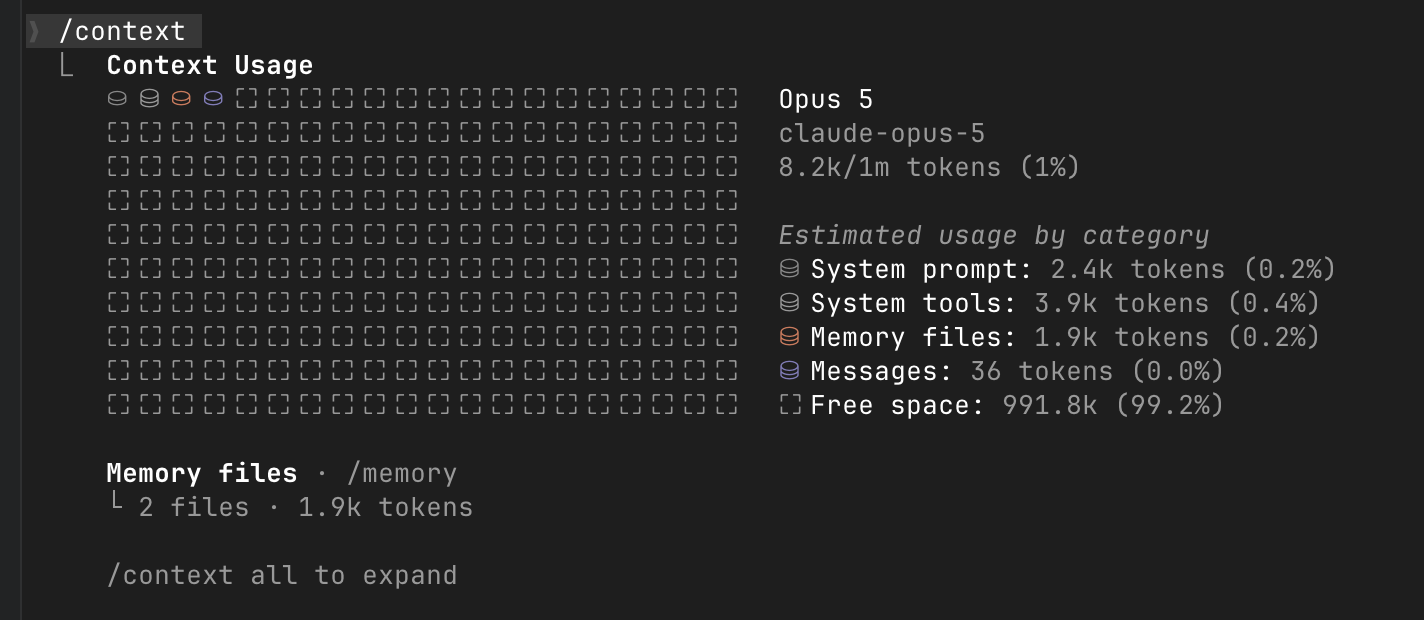
One observed snapshot, not a universal benchmark or billing claim. /context
reports estimates; versions, models, account features, settings, and memory change
the totals. Opting into more capability intentionally uses more context.
The control
Inspect the effective launch before it runs, or copy the managed defaults once and make them yours. Updates never overwrite user-owned configuration.
doctor reports the effective prompt, settings, tools, capability state, memory source, and Claude Code checks.
claude-kiss doctor
CLAUDE_KISS_DRY_RUN=1 claude-kissRun claude-kiss init. From then on, these three files belong to you:
~/.config/claude-kiss/
  prompt.md
  settings.json
memory/CLAUDE.mdThe research
Recent 2026 studies do not prove that one launcher is ideal. They do show that instruction count, visible tools, handoffs, and interface design change how coding agents behave.
Across two scaffolds and four frontier models, the simpler mini-SWE-agent scaffold was more robust to semantics-preserving repository changes than OpenCode.
Across 11,700 trajectories, useful structured tools improved consistency and Python CodeAct cut steps and tokens; scratchpad-style scaffolding had little effect.
Across 247,694 instruction lifetimes, agent prompts grew 226%; preserving rationale enabled dramatic pruning and improved instruction following by up to 23.1%.
For repository questions, direct retrieval scored 65.2% versus 46.2% for planner-to-subagent search; each correct answer cost less than half as much, and 41.8% of failures happened at handoff.
Instruction adherence fell from about 96% with one simultaneous rule to as low as 20% with twenty. More permanent policy can mean less policy followed.
An adaptive system exposed about seven tools instead of fifty while retaining nearly identical retrieval coverage: 90.3% versus 90.8%.
The limit is part of the claim. Structured tools can outperform Bash-only minimalism, and difficult work can justify orchestration. The evidence supports default-minimal and task-relative—not “complexity is always bad.”
Read all eleven studies and the caveatsEvidence
The repository includes eight paired tasks: same fixture, prompt, model, and budget;
ordinary claude versus claude-kiss. The evaluator checks the
resulting files, not just the prose.
Trust boundary
Bash remains powerful. User, project, and local settings—and their
hooks and plugins—still load. Explicit native flags can replace managed defaults.
Tool limits shape attention, not filesystem access. Review permissions, repository
settings, plugins, and MCP configurations as code.
Start small
curl -fsSL https://claude-kiss.com/install.sh | shThen run claude-kiss. Your ordinary claude command remains exactly as it was.